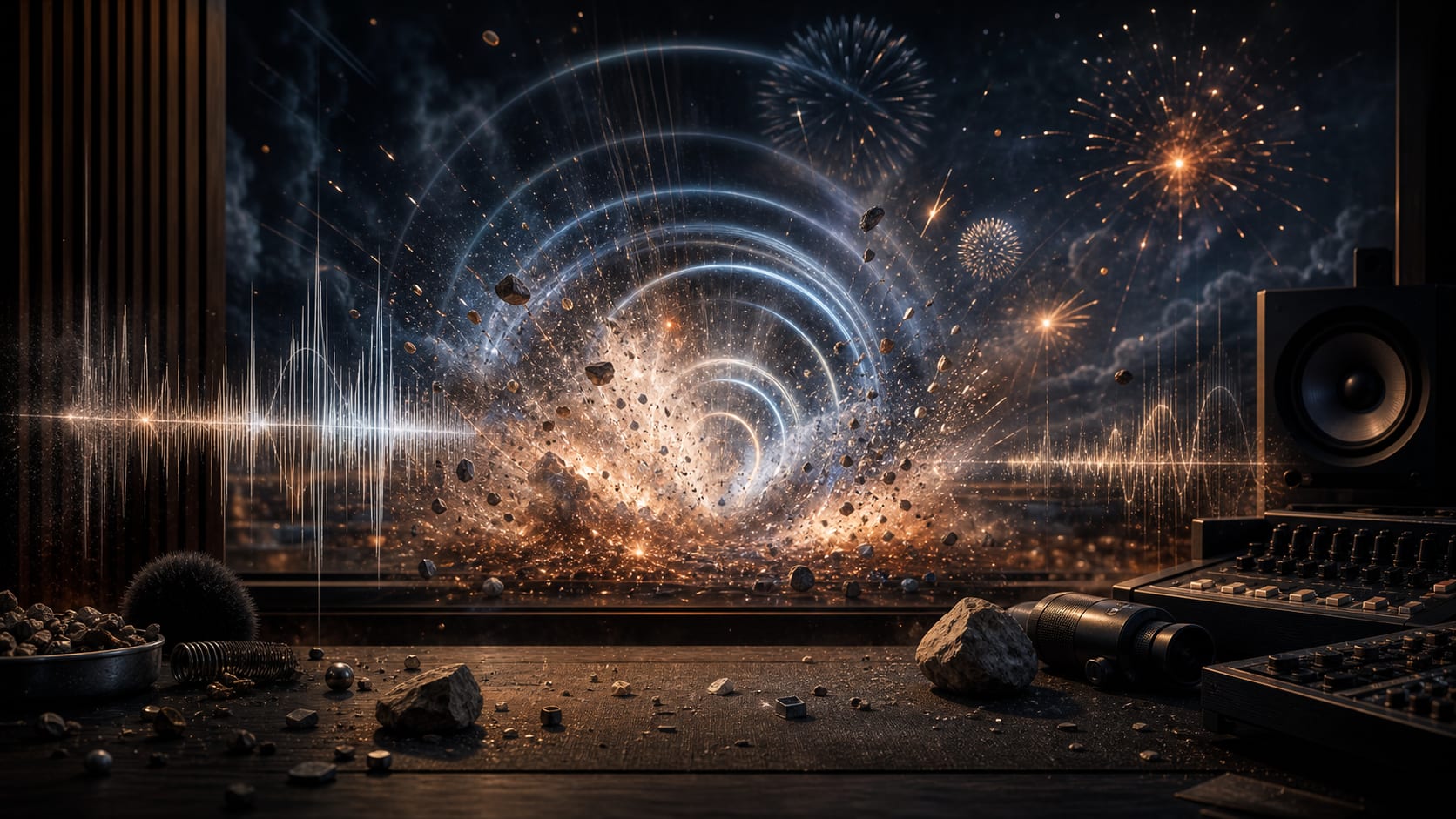
Explosion Sound Effects: Cinematic Booms, Fireworks and Impacts

Quick answer: an explosion sound effect is usually a layered impact made from a low boom, a sharp transient, a pressure wave, debris, and a tail. Fireworks use a similar sound-design language at a smaller scale: launch whistle, burst, crackle, echo, crowd reaction, and outdoor ambience.
Use the player below to preview and download 20 royalty-free explosion sound effects for films, trailers, games, YouTube videos, podcasts, and social edits. The pack is useful for cinematic impacts, action scenes, magic blasts, destructive cuts, title-card hits, and firework-style celebration edits that need controlled bursts instead of phone-recorded chaos.
The most important choice is scale. A building demolition, a sci-fi weapon, a backyard firework, and a trailer boom all need different weight, distance, brightness, and decay. Start with the story beat, then choose the sound that tells the audience whether the moment is dangerous, celebratory, funny, surreal, or enormous.
Explosion sound effects vs firework bursts: what should you use?
Explosion and firework sounds overlap, but they are not interchangeable. Explosions usually imply force, danger, destruction, or sudden transformation. Fireworks usually imply celebration, distance, rhythm, and sparkle. If every July 4 burst sounds like a blockbuster building collapse, the edit can feel oversized and fake. If every action explosion sounds like a tiny firecracker, the scene loses weight.
| Scene | Best starting sound | What to add |
|---|---|---|
| Backyard July 4 video | Firework pop or small burst | Crackle, outdoor air, distant crowd, short echo. |
| Firework finale | Layered bursts with varied timing | Wide ambience, low rumbles, overlapping sparkle tails. |
| Action film explosion | Deep boom with pressure wave | Debris, glass, metal stress, dust, reverb tail. |
| Trailer impact | Short explosion hit or sub impact | Reverse swell, low thud, distortion, fast tail fade. |
| Game or animation blast | Stylized pop, magic burst, or cartoon boom | Pitch movement, UI click, sparkle, or exaggerated debris. |
Firework sound effects for celebration videos
For celebration edits, realism usually comes from perspective. A camera near the crowd should hear chatter, scattered applause, neighborhood reflections, and bursts arriving at slightly different distances. A drone shot or wide skyline angle can use softer, more distant fireworks with longer echoes. A close backyard shot can use sharper pops, fuse crackle, and a little air movement, but it should not become painfully bright.
Build fireworks in layers: start with the visual burst, add a short pop or boom, place a crackle tail after the flash, then tuck in a low rumble only when the firework is large enough to justify it. If the edit includes music, leave space around vocals and snare hits so the fireworks feel synchronized instead of pasted on top.
For travel, brand, summer, or family videos, firework-style bursts do not need to dominate the whole soundtrack. Use one or two clean bursts as scene punctuation, then let summer ambience, music, and crowd sound carry the emotional tone.
What makes an explosion sound effect believable?
A convincing explosion is rarely one file. Sound designers often build it from several smaller pieces so the viewer hears the cause, size, surface, and environment.
- Transient: the first crack or pop that tells the ear exactly when the blast happens.
- Body: the low boom that gives the explosion mass.
- Pressure: a short wave of air, distortion, or sub energy that makes the blast feel physical.
- Debris: rocks, glass, dirt, sparks, metal, or wood that explains what broke.
- Tail: echo, smoke, room tone, or outdoor reflections that place the explosion in a real space.
Once those layers are working, remove anything that does not support the shot. The best explosion is not always the loudest one. It is the one that makes the cut feel inevitable.
Cinematic trailers: Non-diegetic explosions and impacts
Before we get into diegetic sounds that take place within the context of a movie scene, let’s begin with the explosions used in cinematic trailers. It’s common to hear these sounds used in big-budget film trailers.
In the Transformer (2023) trailer above, we can hear massive impact sounds right away. The sounds may be produced by a resonant timpani drum but their design is explosive nevertheless.
Destructive explosion sound effects in film
In a movie scene, explosion sounds often mark moments of chaos and destruction. The quality of explosion sound effects have improved tremendously over the years. We’ll start by exploring classic sounds and then move on to modern examples.
Star Wars and Ben Burtt – The ultimate space explosion
It’s endearing to look back at iconic scenes from the 1977 Star Wars film Empire Strikes back, knowing that these were state of the art special effects at the time. During the Star Wars sound design documentary below, Ben Burtt describes his techniques in detail. We’ve timestamped the section where he explains some of the secrets behind some of their sound design.
“When the Probot blows up, I remember one of the principle elements in that explosion is a big sheet of plywood which we snapped out and back of the building in the parking lot and added it in on top of the explosion itself he dubbed it the wood crack attack explosion … I went to White Sands Missile Range to record missiles and rockets taking off and impacting and air-to-air interceptions. I went to many military bases and recorded tanks shooting and artillery always in a quest which I call the search for the ultimate explosion”
Taken out of context, the Death Star looks like a toy model. The low-frequency, colossal explosion lacks some of the acoustic depth that we’ve come to expect from similar scenes today. John Williams’ timeless film score makes up for it with its complexity and emotional depth. The sound design leading up to the explosion, from the ship powering down to the Doppler effect of the X-wings escaping, evoking a feeling of supreme accomplishment in the war of good against evil.
Die hard, Tenet – Chain reactions and exploding buildings
A single profound explosion like the Death Star provides plenty of space for gradual decay. But in scenes where a chain reaction has been triggered, like this classic moment from Die Hard (1988), the compounded explosion sound effects need special preparation.
This building explosion scene raised the bar for action movies and left a lasting impact on cinema. Bruce Willis, playing the hero John McClane, pushes a bundle of explosives down an elevator shaft in an effort to save a group of hostages.
There’s a moment of profound silence as the explosives drop, followed by nearly 20 seconds of rolling fires, low-frequency booms, and building materials shattering as it leaves a trail of destruction in its wake.
Thirty years later, the Tenet (2020) offered a fresh, mind-bending take on the typical sound design for exploding buildings. It follows a former CIA agent who manipulates the flow of time to prevent attacks that will take place in the future. The scene below highlights a moment where a building explodes in reverse, followed immediately by re-destruction.
This is one of the few moments in cinema where you’ll find a reversed explosion sound effect woven into a plot. Rattling debris accompany the reconstruction of the buildings to add to the build up. By pairing these reversed sounds with actual explosions, the war film achieves a similar rise-and-release effect for the audience.
Mad Max – Exploding cars and the sound of flying debris
The sound design for exploding cars resembles those used with exploding buildings. In the scene below from Mad Max (2015), a series of oil tankers explode in the desert.
Alongside some of the explosive booms, the audience hears whizzing sounds of shrapnel flying through the air like bullets. This adds to the felt sense of risk for the main characters, who could be hit at any moment by a small piece of metal.
Toy Story – Dynamite and firecrackers
Smaller scale explosions, like dynamite and firecrackers, can still pack a punch. In this scene below from Toy Story (1995), the problem child Sid attaches a small stick of dynamite to his toy soldier and blows it up in his back yard.
Notice how the explosions sound effect is followed by the playful clop-clop sound of wooden blocks. This immediately lightens the emotional impact of the sound for the kids in the audience, making it feel a little less scary.
Scanners, Mars Attacks, Monty Python, Jaws – Exploding body parts
Exploding body parts are gruesome and might not be appropriate for all ages. That being said, their sound design differs considerably from the sonic texture of buildings and cars. You’re likely to hear squishing and liquid, representing the biological matter splattering across the environment.
The video above comes from Scanners (1981) may be the most iconic exploding head in film history. Early in the film, a character’s head explodes under the influence of psychic powers. A high pitched frequency leads up to the pivotal moment, symbolizing the pressure building within the character’s skulls and mirroring an actual experience called tinnitus, or ringing in one’s ears.
Sometimes an exploding head can be funny, like this scene from Mars Attacks (1996) when an innocent grandmother accidentally discovers how to defeat the evil invaders by playing country music. The foley for this scene is unique because the exploding brains are contained within glass. As the aliens screech and top on their helmets, we watch their brains grow like a balloon before exploding within the container. The acoustic decay is cut off abruptly because the glass stays in tact.
Stomachs are another body part that have been known to explode, particularly in comedies. The video above is from Monty Python’s Meaning of Life (1983). A grotesque man eats until his stomach explodes. Notice the wet sound of his innards landing across different areas of the room. These are classic “biological” sounds associated with exploding bodies.
Filmmakers have been known to experiment with exploding animals as well. In Jaws (1975), an air compression tank is stuffed into the shark’s mouth while it’s trying to sink the ship. As it circles the boat, a series of gun shots ring out before hitting the mark and causing the shark to explode. We hear a standard boom followed by the shark guts splashing out around the surface of the ocean.
The Abyss – Underwater explosion sounds
Sounds travel through air differently than they do underwater. It follows that underwater explosions would feature low-frequency, resonant booms due to the water’s density. Shockwaves from the explosion can also be visualized as rapidly expanding rings or bubbles, adding to the dramatic effect. Sound designers often use a combination of real underwater recordings and synthesized sounds to create the desired effect for cinema.
When a submarine sinks in The Abyss (1989), we see and hear an initial cracking and scraping of the glass case as it buckles under atmospheric pressure. These sounds are coupled with a haunting layer of dissonant strings in the soundtrack. We hear the submariner yell as he recognizes that he’s out of luck. There’s a massive explosion but the sound lasts only two seconds before it dissipates in the water and a column of bubbling sounds rise to the surface.
Life-generating explosion sound effects in movies
Explosions are not always limited to destructive purposes. We find similar effects used to represent the creation of the universe and other life-generating moments.
Tree of Life, The Fountain – Explosions at the center of the galaxy
The scene above, from Terrence Malick’s film Tree of Life (2011), features a perpetual rumbling explosion that emanates from the center of the galaxy. Paired with a bold and operatic melody, this sound effect has an intense and profound impact on how the audience perceives the story.
A reverse-explosion effect is used in The Fountain (2006) to convey a climactic moment of cosmic unity. Preceded by a similar rumbling to the sounds heard in Tree of Life, the film’s soundtrack takes the lead sonically and conveys the character’s emotional state.
Creating your own explosion sound effects
Disclaimer: Audio Design Desk doesn’t sell link placements or place affiliate links in any article. We’ve added callouts with links in this next section, in order to help you find the right tools for the job. We are not partnered with any of these companies.
Designing large explosions and impact sound effects involves careful adjustment of signal flow and the application of various audio effects. Here’s a detailed guide on how to achieve impactful and immersive explosion sounds.
Step-by-Step Guide to Designing Explosion Sound Effects
1. Capturing and Selecting Source Sounds
- High-Quality Recordings:
- Use recordings of real explosions, impacts, and other explosive sounds such as fireworks, gunshots, and industrial impacts.
- Synthetic Sounds:
- Combine synthesized elements like low-frequency rumbles, white noise bursts, and sub-bass hits to enhance the impact and fullness of the explosion.
2. Adjusting Signal Flow
- Applying Convolution Reverb:
- Direct Application:
- Apply convolution reverb directly to the explosion sound to transform the entire sound, including its character and spatial qualities.
- Plugin Recommendations: Altiverb, Waves IR1, Logic Pro’s Space Designer.
- Choose a large, outdoor impulse response to simulate the expansive environment of an explosion.
- Adjust the reverb parameters to enhance the sense of space and depth.
- Parallel Application:
- Apply convolution reverb in parallel to the explosion sound to add reverb as a separate layer, allowing the original sound to remain clear while adding reverberated echoes.
- Set up a send/return channel in your DAW and apply the convolution reverb to the return channel.
- Blend the wet reverb signal with the dry explosion sound to achieve the desired balance.
- Direct Application:
3. Applying Distortion
- After Reverb:
- Apply distortion after reverb to excite the entire sound, including the reverb tail, making the explosion sound much larger and more aggressive.
- Plugin Recommendations: Output Thermal, Soundtoys Decapitator, iZotope Trash 2.
- Adjust the drive and mix settings to blend the distorted and clean signals.
- Use multi-band distortion to apply different levels of distortion to various frequency ranges.
- Apply distortion after reverb to excite the entire sound, including the reverb tail, making the explosion sound much larger and more aggressive.
- Before Reverb:
- Apply distortion before reverb to enhance the sound being reverberated, adding harmonic richness and intensity to the initial explosion.
- Apply distortion to the dry explosion sound, then send it to the reverb channel.
- This technique retains the clarity of the reverb tail while enhancing the body of the explosion.
- Apply distortion before reverb to enhance the sound being reverberated, adding harmonic richness and intensity to the initial explosion.
4. Layering and Enhancing the Explosion Sound
- Layering Sounds:
- Combine multiple layers of explosion sounds, including low-frequency rumbles, mid-range impacts, and high-frequency debris.
- Balance the levels and panning of each layer to create a full, immersive sound.
- Combine multiple layers of explosion sounds, including low-frequency rumbles, mid-range impacts, and high-frequency debris.
- Adding Sub-Bass:
- Add a sub-bass layer to reinforce the low end and add weight to the explosion.
- Use a synthesizer to generate a sub-bass tone, or use a dedicated sub-bass plugin like SubBoomBass or R-Bass.
- Add a sub-bass layer to reinforce the low end and add weight to the explosion.
- Transient Shaping:
- Use transient shapers to enhance the initial attack of the explosion, making it more impactful.
- Plugin Recommendations: SPL Transient Designer, Waves Smack Attack, Logic Pro’s Enveloper.
- Use transient shapers to enhance the initial attack of the explosion, making it more impactful.
5. Fine-Tuning and Mixing
- EQ and Compression:
- Apply EQ to shape the final sound, removing any unwanted frequencies and enhancing the desired characteristics.
- Use a low-cut filter to remove subsonic rumble and a high-cut filter to tame harsh high frequencies.
- Use compression to control dynamics and glue the layers together.
- Apply a limiter to ensure the explosion sound remains within a controlled dynamic range without clipping.
- Apply EQ to shape the final sound, removing any unwanted frequencies and enhancing the desired characteristics.
- Automation:
- Automate volume, panning, and effect parameters to add movement and variation to the explosion sound.
- Create dynamic builds and releases to simulate the natural progression of an explosion.
- Automate volume, panning, and effect parameters to add movement and variation to the explosion sound.
Tip for Effective Explosion Sound Design
- Experiment with Signal Flow: Changing the order of effects like reverb and distortion can drastically alter the sound, so experiment to find the best combination.
- Layering for Depth: Combine multiple layers to create a rich, complex explosion sound that covers the entire frequency spectrum.
- Automation for Dynamics: Use automation to add dynamic changes and movement, enhancing the realism and impact of the explosion.
- Attention to Detail: Fine-tune each element to ensure a polished, professional result.
By following these steps and tips, you can create powerful and immersive explosion sound effects that add excitement and realism to your audio projects. Experiment with different techniques and effects to develop your unique sound design style.
To save time on sound design, start with the royalty free sound effects we’ve provided in this article or download Audio Design Desk for an even more expansive collection.
Common explosion sound effect mistakes to avoid
Explosion sounds get worse when every layer tries to be huge. A strong blast usually needs one clear job at a time: a transient for timing, a body for weight, debris for story, and a tail for space. If all four layers are fighting for the same frequency range, the result becomes loud but small.
- Using the same boom for every shot. A firework, a car blast, a spaceship hit, and a trailer impact should not all have the same scale or decay.
- Forgetting distance. A wide skyline firework can have a soft delayed tail; a close action blast needs sharper pressure and less sparkle.
- Ignoring debris. The audience believes the explosion partly because they hear what broke: glass, dirt, metal, rock, wood, or air.
- Overloading the low end. Sub energy is powerful, but too much of it can bury music, dialogue, and the transient that sells the cut.
- Leaving no silence. A tiny pause before or after the blast can make the explosion feel bigger than another layer of noise.
Related sound effects to layer with explosions
Explosion scenes often need more than one boom. Try pairing this pack with thud sound effects for body and impact, glass breaking sound effects for windows and debris, fire sound effects for aftermath, dramatic sound effects for trailer tension, and ambient sound effects for smoke, distance, and environment.
Explosion sound effects FAQ
What is the difference between an explosion and a firework sound effect?
An explosion sound effect usually suggests destructive force, mass, pressure, and debris. A firework sound effect is usually brighter, smaller, more rhythmic, and more celebratory, with pops, crackles, whistles, and outdoor echo.
How do I make explosion sound effects feel bigger?
Layer a clean transient, a low boom, debris, and a tail. Then use volume automation, EQ, saturation, and reverb to match the distance and environment of the shot. Bigger does not always mean louder; it often means wider, lower, and better timed.
Can I use explosion sound effects in YouTube videos and social posts?
Yes, if the sound is licensed for your use. The downloadable sounds on this page are royalty-free, but always check the current usage rights for your project type before publishing commercial work.
What sounds pair well with explosions?
Impacts, thuds, glass breaks, metal hits, fire, whooshes, dirt, rocks, crowd reactions, and ambience all pair well with explosions. The right layer depends on what explodes and where the scene takes place.